


A contract lands in your inbox. You’re a freelancer, a consultant, a founder. The work is good, the client is real, the money matters. You open the PDF and, assuming you read it at all, you do one of five things.
I’ve watched all five play out on Reddit threads, in DMs, in the messages I get every week from people who’ve signed something they shouldn’t have. Every one of them fails. Not in theory. In documented, repeatable, financially-painful ways.
Here’s what people are actually doing, and why each one breaks.
1. Just sign it
What people are trying: Skim the contract. Trust the client. Sign.
It’s the £1,000 project, or the £5,000 retainer, or the supplier T&Cs that came attached to an order confirmation. The number feels small enough to not worry about. The relationship feels established enough to not interrogate. So you sign.
Why it fails: This is the single most common root cause of every freelance and founder horror story I have come across. The contractor whose company “only signed an invoice” and ended up with no enforceable agreement. The scope creep trap where every “can you just also…” was absorbed into the original fee. The unlimited liability clause buried on page seven. The seven-year non-payment saga that started with a handshake and a Google Doc.
The psychology underneath is the same every time. People don’t push back because they think they have no leverage, they’re scared of looking difficult, and they assume the terms are fixed. All three are wrong. The contract is impenetrable, so they sign anyway.
The £1,000 contract you didn’t read is the one that creates the £20,000 problem.
2. Use a template
What people are trying: Download a Bonsai, Rocket Lawyer, Contract Killer or Freelancers Union template. Find-and-replace the name. Send.
This is the most common “I am being responsible about this” move. Founders do it for supplier agreements. Freelancers do it for client engagements. It feels like a real step.
Why it fails: Templates are static and generic. They don’t know your situation. They don’t know whether you’re the buyer or the supplier, what your non-negotiables are, or whether the deal involves AI training data, regulated information, or an end-client behind the end-client.
Most templates are written from a single point of view, usually the vendor’s, with broad wording, defaults that favour whoever drafted them, and missing modern provisions (remote work, AI inputs, data licensing). They cannot ask whether the deal involves training data, regulated information, or an end-client behind the end-client. They cannot ask whether you are the buyer or the supplier. They just sit there, identical to the version someone else downloaded last week.
The downstream damage is well-documented in UK data. IPSE’s research shows half of self-employed people in the UK have completed work they were never paid for. Up from 43% in 2018. 35% had an invoice paid late in the last twelve months. The average freelancer is owed £5,230 in outstanding invoices at any given time. One in five has been left without money to cover basic living costs because of it. Freelancers spend an average of 20 days a year chasing payment that should already have arrived.
A template doesn’t cause that. But a template doesn’t prevent it either. It looks complete, which is worse than having nothing. It creates false confidence that “the contract” has been handled, when the clauses that would actually have made a difference are missing.
3. Paste it into ChatGPT
What people are trying: Drop the contract into ChatGPT or Claude. Ask “anything I should worry about?” Take the bullet points as a review.
This is now the default advice on r/smallbusiness. It feels modern. It feels free. It feels like the obvious move.
Everything in this section can be partially addressed with a better prompt. A tech-savvy user who spends 45 minutes constructing the right context, asking the right commercial questions, and knowing what to push back on will get a materially better output. Most people reviewing a contract at 11pm before a 9am meeting are not doing that. They are asking “is this ok” and trusting what comes back. This section is about what the output is missing, and why the gap matters when your money is on the line
Why it fails: Five concrete reasons, all documented.
No framework. General-purpose AI works descriptively, not evaluatively. It can tell you what’s there. It cannot tell you what’s missing. It won’t spot the absent liability cap, the missing late-fee clause, the non-existent kill fee. Here is the line I keep coming back to: ChatGPT can tell you what is present in your contract. It cannot tell you what must be present. That single sentence is the whole problem.
Hallucinations. General models confidently invent clauses, statutes, and case law. With a contract, the cost of not knowing which sentences are real is not an embarrassing email. It is a clause you relied on that doesn’t exist.
No severity rating. ChatGPT will return fifteen ‘concerns’ in a single bulleted list unless you know to ask otherwise. Most people don’t. And even when prompted for ranking, it applies no commercial framework. It weights by legal complexity, not by what will cost you most if triggered.
No jurisdictional awareness. Defaults to US ‘work made for hire’ language and US contract conventions. Most of it doesn’t work under English law. Some of it actively misleads.
No action. It explains the clause. It does not give you the exact words to send back to the other side, that their lawyer will review and accept. Which means the moment you finish reading the AI output, you’re back to square one. Staring at the contract, not knowing what to do next.
4. Pay a lawyer
What people are trying: £50 to £450+ for a one-off review. r/freelance veterans recommend it. Some try LegalShield at $50/month.
Why it fails: Economically irrational for the £500–£5,000 contracts that make up most freelancer and SME work. A £450 review on a £1,000 contract destroys the margin before the project starts. So in practice, people don’t do it. They go back to option 1 or option 3.
The lawyer route only makes sense once contract values are high enough that a £450 review is a rounding error. Below that line, which is where most of the freelancer and early-stage founder market actually lives, it’s a wall, not a door.
5. Subscribe to an enterprise tool
What people are trying: A SaaS subscription that handles “all their legal” such as LegalZoom, Rocket Lawyer, goHeather, ContractKit, Spellbook, Juro, LegalOn, Evisort.
Why it fails: Wrong shape for the buyer.
The market is split into two tiers. Sub-$10 individual tools that don’t actually review anything, and $99 to $1,200+/month enterprise platforms designed for legal teams reviewing hundreds of contracts a month. There’s almost nothing in between.
A freelancer who signs three contracts a year is not the buyer for a $99/month subscription. A founder closing two supplier deals a quarter isn’t either. LegalZoom in particular gets complained about consistently — fine for filing forms, poor value for anything more substantial. Subscriptions sit unused. Per-contract pricing barely exists, except in a small handful of newer entrants.
So people sign up, don’t use it, cancel, and go back to option 1 or option 3.
The pattern
Every option fails on at least one of four axes that actually matter to the person signing the contract:
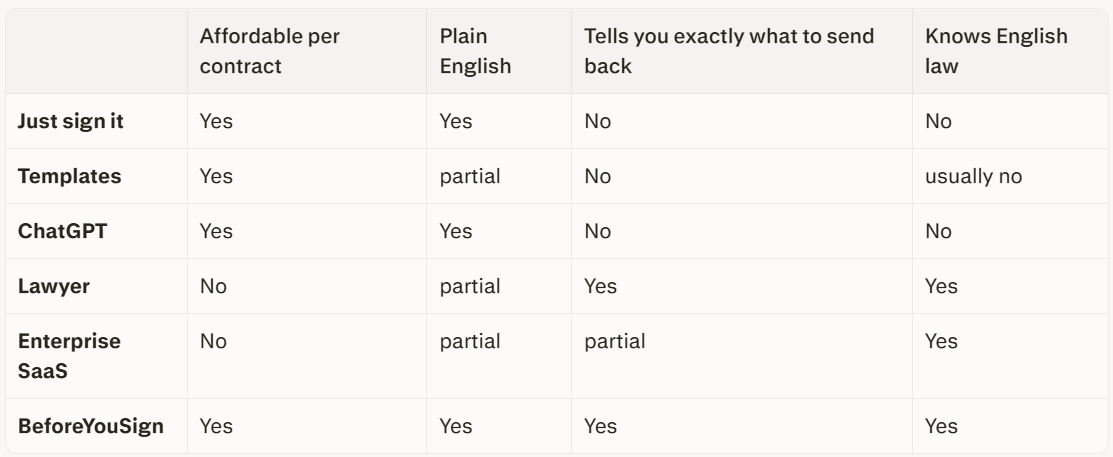
The white space isn’t subtle. It’s the entire intersection of those four columns. Affordable enough to use on a £1,000 contract, plain enough to read without a law degree, specific enough to give you the exact counter-language to send, and built for the jurisdiction you’re actually contracting in.
Nobody else is sitting in all four boxes at once.
That’s the gap. That’s the wedge. That’s what BeforeYouSign is built for.
What to do today
Whether you’re a founder reviewing supplier T&Cs, or a freelancer staring at the next services agreement, the move is the same. Stop using tools that weren’t designed for the size of the deal in front of you.
If the contract is worth less than £5,000 and you’ve been about to do options 1, 2 or 3, try the option that was actually built for that range. First review is free